

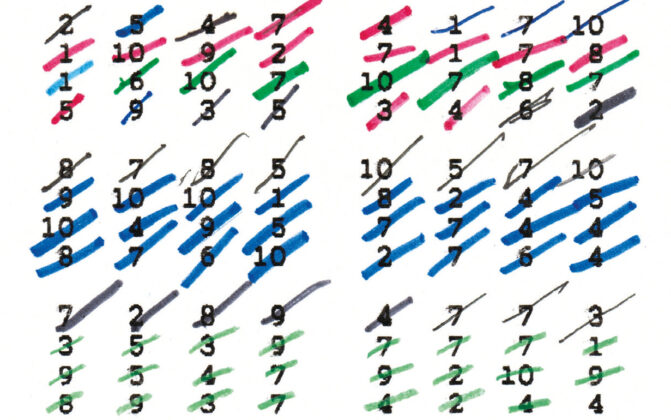
640 numbers between 1 and 10, © The John Cage Trust
(red.) In 1991, John Cage notated his project Museumcircle as follows: “To make an exhibition in the museum (of a specific town) of articles from other museums (of the same town), hung or placed in chance-determined positions. To bring this about, each museum may offer to loan, say, a dozen objects. From this potential source, chance operations will be used to select the actual ones to be used.” This simple but precise concept aims towards the complete dehierarchization of objects from a wide range of collections. The exhibition shows the loans non-chronologically, ahistorically, and decontextualized. The composer and artist thus withdrew the objects from the interpretive authority of museums, which is otherwise manifest in the arrangement, reconstruction, and valuation of historical artifacts and contexts.
„Museumcircle“
In 1991, John Cage notated his project „Museumcircle“ as follows: “To make an exhibition in the museum (of a specific town) of articles from other museums (of the same town), hung or placed in chance-determined positions. To bring this about, each museum may offer to loan, say, a dozen objects. From this potential source, chance operations will be used to select the actual ones to be used.” This simple but precise concept aims towards the complete dehierarchization of objects from a wide range of collections. The exhibition shows the loans non-chronologically, ahistorically, and decontextualized. The composer and artist thus withdrew the objects from the interpretive authority of museums, which is otherwise manifest in the arrangement, reconstruction, and valuation of historical artifacts and contexts.
The final selection of the works and their placement in the exhibition space are based on chance—a principle John Cage adopted from Marcel Duchamp. Here, he was referring to Duchamp’s works such as „Erratum Musical“ (1913) and „3 stoppages étalon“ (1913–14). For „Erratum Musical“, the notes of a composition were chosen randomly, and in the case of „3 stoppages étalon“, Duchamp dropped a horizontally held one-meter-long thread from a height of one meter. After performing this procedure a second and third time, he fixed the three threads with varnish exactly as they had landed. Mounted on wooden measuring sticks, they formed new standards of chance to serve as a guideline for the art of the twentieth century. Cage gave expression to this in his „26 Statements Re Duchamp“ (1963), for example: “One way to write music: study Duchamp.”
In the late 1970s, taking the „I Ching“—the ancient Chinese „Book of Changes“—as his point of departure, John Cage collaborated with the composer Andrew Culver to develop the so-called “random generator,” a computer-aided method to replace the casting of dice or a coin to arrive at random choices. Independent of epoch, format, material, or genre, a method such as this one also insists on the intrinsic esthetic nature of the individual object, in keeping with the notion of the „objet trouvé“. According to the artist, the „Museumcircle“ is not an exhibition in the traditional sense, but rather a composition for a museum, a kind of quodlibet, a simultaneous sonority of the kind Cage used as far back as 1949. Subtly anarchical and at the same time liberating, already the title implies a roundelay in which several acts take place simultaneously. The show allows its visitors to decide entirely at their own discretion which objects they would like to pay particular attention to and, in the process, to experience whatever comparisons or analogies, dissonances, or even surprising coincidences that ensue for them.
On the occasion of this exhibition project by John Cage, the MUSEUMMMKFÜR MODERNE KUNST is bringing all of Frankfurt’s museums together for the first time. Opening on 11.12.2021.